Photochemistry: Driving Sustainable Innovation in Modern Chemistry
White Paper CDMO November 2025
Arxada is committed to advancing chemistry through innovative technologies. Photochemistry is emerging as a tool in synthetic chemistry, offering significant sustainability advantages. As the world seeks greener and more efficient processes, could photochemistry become an important part of the modern chemistry toolbox?
Photochemistry: Driving Sustainable Innovation in Modern Chemistry
Photochemistry is gaining momentum in synthetic chemistry, as evidenced by the increasing number of publications and research activities over recent years. This technology leverages light as an energy source, utilizes advanced irradiation technologies, and aligns with key green chemistry principles. Its versatility spans numerous transformations and provides novel synthetic routes not accessible via thermal or electrochemical methods. This paper explores why photochemistry is transforming synthetic chemistry and how Arxada is positioned to leverage this technology to deliver greener solutions.
Traditionally, heat in the form of steam has been used to drive chemical reactions in industrial settings, resulting in significant greenhouse gas emissions due to combustion of fossil fuels1,2. In contrast, photochemical reactions use light as the primary energy source, enabling chemical transformations through photon-driven mechanisms rather than thermal activation3. The electricity required to generate this light can be sourced from renewable energy systems such as solar panels, hydroelectric plants, and wind farms. By decoupling reaction energy from fossil fuel combustion, photochemistry offers a pathway to significantly lower carbon emissions and improved sustainability. Another important aspect of photochemical processes is the choice of a light source. Historically, mercury vapor lamps were the standard, providing high-intensity UV light but posing significant drawbacks, including high energy consumption, unwanted heat generation and limited wavelength control. In recent years, light-emitting diodes (LEDs) have revolutionized photochemistry by offering precise wavelength tuning, lower energy requirements, and minimal heat output. LEDs also enable safer, more sustainable operations and can be integrated into continuous-flow systems for improved scalability and reproducibility4. Their long lifespan and compatibility with renewable electricity sources further enhance the green aspects of photochemical technologies, making LEDs the preferred choice for modern synthetic applications.
Photochemistry naturally fulfills some of the key principles of green chemistry (Figure 1), such as atom economy, design of energy efficiency, reduction of derivatives, and catalysis. While not all green chemistry principles are automatically achieved, many can be integrated through sustainability-oriented smart process design5. The basic characteristics of photochemistry make it possible to design processes that consume fewer resources and generate less waste. Beyond the environmental benefits, photochemical methods possess the potential to simplify complex syntheses by cutting down the number of steps required to produce advanced molecules, a feature that can dramatically lower costs and improve scalability. Furthermore, photoredox catalysis, a subset of photochemistry that combines light with redox-active catalysts, adds another layer of sustainability by enabling highly selective transformations under mild conditions6. Together, these developments make photoreactions a frequently used tool in the context of green chemistry7.
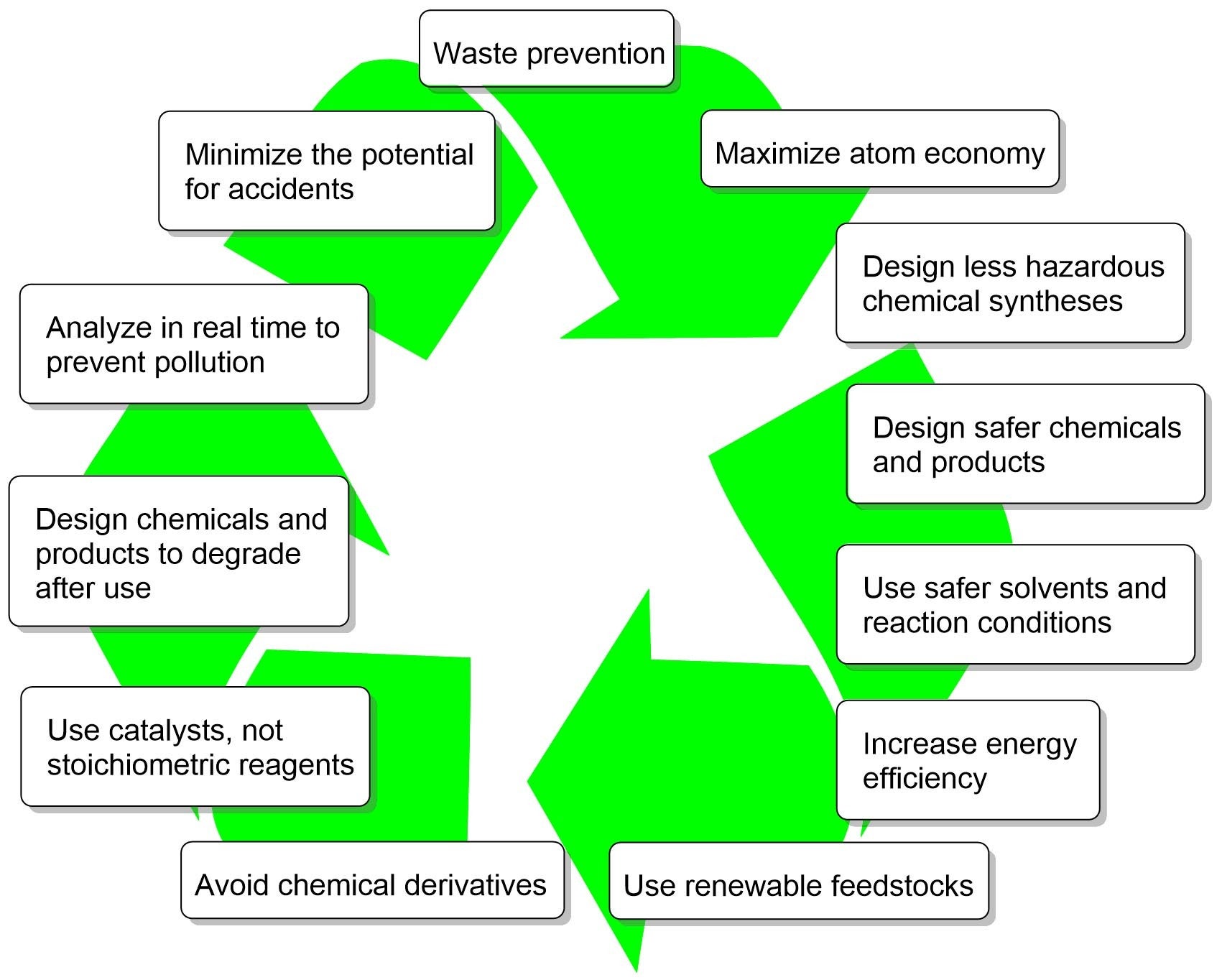
Figure 1: The 12 principles of green chemistry8
A fascinating aspect of photochemical reactions is their diversity. As photochemical reactions are defined as such by their source of energy, many different transformations fall under the category of photochemical reactions. Figure 2 shows representative examples of [2+2]-cycloadditions9, isomerization of double bonds10, or photo(redox) catalysis6. The large number of photochemical reactions allow facile access to many different chemical moieties, which may be otherwise thermally inaccessible, harder to synthesize, or require hazardous reagents. For instance, the formation of cyclobutane through [π2s + π2s]-cycloaddition is photochemically allowed but thermally forbidden11. Another example of a photochemical reaction is photooximation12, which allows the synthesis of lauryl lactam at a multi-ton scale. In addition, photooxygenation is used in the industrial synthesis of rose oxide13. These examples demonstrate that the diversity of photochemical transformations is mirrored by the variety of products they can generate (Figure 2).
Photochemistry, while a powerful and sustainable tool, does not come without challenges. Scaling up photochemical reactions is difficult due to limited light penetration in large reactors, complex heat and mass transfer, and reproducibility issues caused by variations in light sources. High equipment costs and reliance on expensive photocatalysts add further hurdles14. Continuous-flow photochemistry together with modern light sources helps overcome these barriers by ensuring uniform irradiation and precise control of reaction conditions. Modular reactor designs allow numbering-up instead of sizing-up, and flow systems also integrate inline monitoring for better reproducibility and safety. These advances have already been applied in production of pharmaceutical ingredients and fine chemicals15.
Figure 2. Track record of on-site external audit between 2021-2024
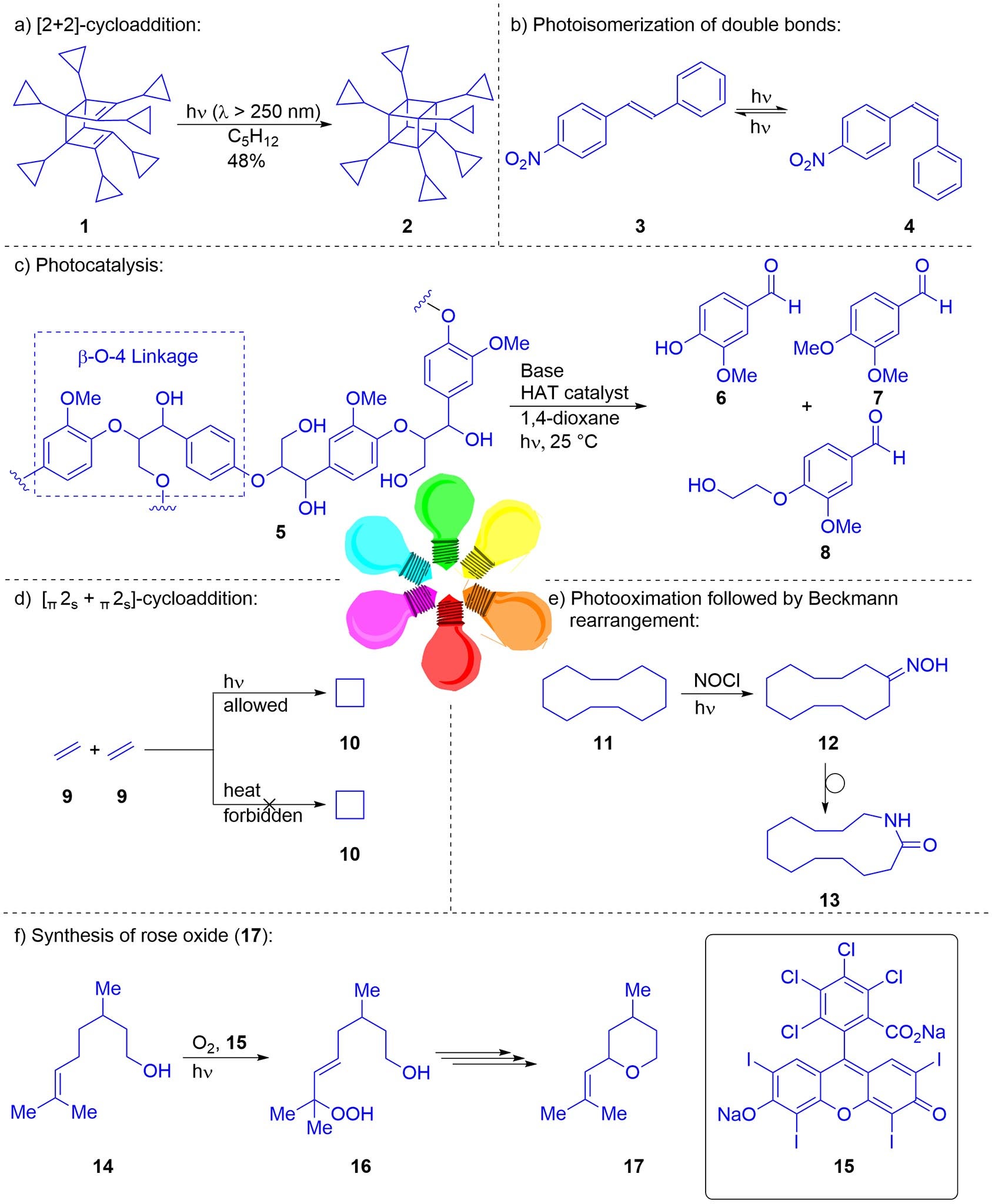
Figure 2: Examples of photoreactions: a) Synthesis of cubane derivative (2) by [2+2]-cycloaddition, b) photoisomerization of (E)-1-nitro-4-styrylbenzene (3)11, c) photocatalysis using lignin (5) as starting material12, d) [π2s + π2s]-cycloaddition of ethen (9)13, e) photooximation of cyclododecane (11)14, f) synthesis of rose oxide (17) starting from 3,7-dimethyloct-6-en-1-ol (14) using rose bengal (15)15.
Arxada is committed to making its chemistry greener and safer. Our R&D team actively explores innovative reactions, aiming at implementing advanced sustainable alternatives to conventional processes. Our Visp site benefits from the Swiss power grid, which generates approximately 80% of its energy from emission-free sources16, further reducing our environmental impact. Equipped with state-of-the-art machinery in our laboratories, we can develop photochemical processes in both flow and batch configurations. With proven expertise in scaling various chemical reactions from gram quantities to multi-ton production, we combine technical know-how with cutting-edge technology. This allows us to develop and optimize novel processes, and pave the path to industrial scale, delivering sustainable and high-performance solutions for our customers.
Summary
Photochemical reactions represent a dynamic area of research. Their appeal lies in the unique energy source - light, combined with the ability to create diverse molecular structures and the potential for sustainable, green processes. Due to its versatility, photochemistry is becoming an attractive tool in modern chemistry. At Arxada, we bring extensive expertise in reaction development, both in flow and batch processes, alongside a strong commitment to green chemistry. Leveraging our agile CDMO (Contract Development and Manufacturing Organization) approach and tailor-made solutions, we are ready to unlock the full potential of photochemistry for your product pipeline.
Our offer
- Fully integrated CDMO services
- Proven expertise in scaling chemical reactions from gram quantities to multi-ton production
- Experience in batch and flow chemistry
- Sillver EcoVadis Medal 2025, advancing from Bronze in 2023, ranking Arxada in top 15% for sustainability
- Focus on what matters to you
Authors information

Philipp Kohler
Technical Evaluation Manager CDMO

Vratislav Stovicek
Business Development Analyst CDMO

Britta Maria Kübber
Trainee R&D Chemist
Technical Evaluation & Development
References
(1) Total greenhouse gas emissions in the chemical industry (Indicator). https://www.eea.europa.eu/en/european-zero-pollution-dashboards/indicators/total-greenhouse-gas-emissions-in-the-chemical-industry (accessed 2025-11-29).
(2) Golwalkar, K. R. Production Management of Chemical Industries; Springer International Publishing: Cham, 2016. https://doi.org/10.1007/978-3-319-28253-4.
(3) Liu, X. Overview on Photochemistry and Its Applications. Res. Rev. J. Chem. 2021, 10 (12), 1–1.
(4) Beil, S. B.; Bonnet, S.; Casadevall, C.; Detz, R. J.; Eisenreich, F.; Glover, S. D.; Kerzig, C.; Næsborg, L.; Pullen, S.; Storch, G.; Wei, N.; Zeymer, C. Challenges and Future Perspectives in Photocatalysis: Conclusions from an Interdisciplinary Workshop. JACS Au 2024, 4 (8), 2746–2766. https://doi.org/10.1021/jacsau.4c00527.
(5) Bochet, C. G. On the Sustainability of Photochemical Reactions. CHIMIA 2019, 73 (9), 720–720. https://doi.org/10.2533/chimia.2019.720.
(6) Crisenza, G. E. M.; Melchiorre, P. Chemistry Glows Green with Photoredox Catalysis. Nat. Commun. 2020, 11 (1), 803. https://doi.org/10.1038/s41467-019-13887-8.
(7) Oelgemöller, M.; Jung, C.; Mattay, J. Green Photochemistry: Production of Fine Chemicals with Sunlight. Pure Appl. Chem. 2007, 79 (11), 1939–1947. https://doi.org/10.1351/pac200779111939.
(8) US EPA, O. Basics of Green Chemistry. https://www.epa.gov/greenchemistry/basics-green-chemistry (accessed 2025-11-29).
(9) Poplata, S.; Tröster, A.; Zou, Y.-Q.; Bach, T. Recent Advances in the Synthesis of Cyclobutanes by Olefin [2 + 2] Photocycloaddition Reactions. Chem. Rev. 2016, 116 (17), 9748–9815. https://doi.org/10.1021/acs.chemrev.5b00723.
(10) CIS-TRANS PHOTOISOMERIZATION OF 4-NITROSTILBENES. In Photochemistry–7; Pergamon, 1979; pp 279–297. https://doi.org/10.1016/B978-0-08-022358-2.50011-9.
(11) Sankararaman, S. Pericyclic Reactions - A Textbook: Reactions, Applications and Theory; John Wiley & Sons, 2005.
(12) Pape, M. Industrial Applications of Photochemistry. Pure Appl. Chem. 1975, 41 (4), 535–558. https://doi.org/10.1351/pac197541040535.
(13) Michelin, C.; Lefebvre, C.; Hoffmann, N. Les Reactions Photochimiques à l’échelle Industrielle. Actual. Chim. 2019, No. 436, 19–27.
(14) Zondag, S. D. A.; Mazzarella, D.; Noël, T. Scale-Up of Photochemical Reactions: Transitioning from Lab Scale to Industrial Production. Annu. Rev. Chem. Biomol. Eng. 2023, 14, 283–300. https://doi.org/10.1146/annurev-chembioeng-101121-074313.
(15) Horáková, P.; Kočí, K. Continuous-Flow Chemistry and Photochemistry for Manufacturing of Active Pharmaceutical Ingredients. Molecules 2022, 27 (23), 8536. https://doi.org/10.3390/molecules27238536.
(16) CountryReport2024_Switzerland_final.Pdf. https://www.ieabioenergy.com/wp-content/uploads/2024/12/CountryReport2024_Switzerland_final.pdf (accessed 2025-12-09).
Acknowledgments
This work was funded by Arxada AG, Peter Merian-Strasse 80, 4052 Basel, Switzerland.
For further information and/or if you would like Arxada to support your project(s), get in touch with:
Arxada is an industry leader in science-based specialty chemicals that creates innovative chemistry and solutions. Comprised of two business units, Arxada’s Microbial Control Solutions (MCS) business provides more sustainable, science-based solutions that utilize differentiated capabilities in microbiology, actives delivery and formulation chemistry. Its manufacturing and unmatched regulatory expertise meets customer needs in variety of endmarkets, specifically, Professional Hygiene, Home & Personal Care, Paints & Coating, Wood Protection and Material Protection. Arxada’s Nutrition, Care & Environmental (NCE) business serves the needs of our partners in a diverse range of industries including food and feed supplements, aerospace, electronics, renewables, agriculture and industrial, as well as pharma intermediates. Leveraging our strong vertical integration into chemical building blocks, such as ethylene, acetylene, ketene/diketene and HCN, along with our fermentation capabilities and our deep technical expertise, NCE transforms customer needs into high performing solutions. This is achieved through direct product supply or contract development and manufacturing (CDMO). With major sites strategically located in the heart of Europe, Arxada secures its customers’ supply chains, while actively supporting their sustainability efforts.
Headquartered in Basel, Switzerland, the company’s global footprint spans 24 production sites and 14 R&D centers. Its 3,400 associates contribute daily to its overall success.
To learn more about Arxada, please visit: arxada.com and Arxada on LinkedIn
Disclaimer
All information in this presentation corresponds to Arxada’s knowledge on the subject at the date of publication, but Arxada makes no warranty as to its accuracy or completeness and Arxada assumes no obligation to update it. All information in this presentation is intended for use by recipients experienced and knowledgeable in the field, who are capable of and responsible for independently determining the suitability and to ensure their compliance with applicable law. Proper use of this information is the sole responsibility of the recipient. Republication of this information or related statements is prohibited. Information provided in this presentation by Arxada is not intended and should not be construed as a license to operate under or a recommendation to infringe any patent or other intellectual property right. All trademarks belong to Arxada or its affiliates or to their respective third parties and are used here only for informational purposes. Copyrighted material has been produced with permissions or under license, all other materials.
© 2025 Arxada Ltd.