Safety: The Core Driver of Operational Excellence in Biotechnology CDMO
White Paper CDMO March 2026
At Arxada, we embrace a simple but powerful principle – when safety is genuinely mastered, everything else follows. A workplace where risks are systematically removed, deviations are openly addressed, and every employee feels responsible for preventing harm is also a workplace where processes run reliably, communication flows efficiently, and operational discipline becomes second nature. Let us dive deeper into how this historically grounded philosophy shapes our industrial biotechnology operations and why maintaining a top‑tier safety culture remains Arxada’s most important commitment.
Safety: The Core Driver of Operational Excellence in Biotechnology CDMO
In a biotechnology manufacturing plant, the core purpose of Health and Safety is consistent with that of any other business: to operate without incidents that jeopardize employee health or safety, without causing adverse environmental impacts, and without experiencing process-related incidents. Arxada’s biotechnology manufacturing site has been operating for many years with an exceptional Environmental, Health and Safety (EHS) record. The site has achieved over 12 years without a Lost Time Injury (LTI) and has experienced no severe process or environmental incidents. This performance results from a systematic, preventive, and risk‑based approach to EHS management, supported by strong employee engagement and rigorous operational discipline. This paper provides an overview of the key principles, processes, and organizational practices that underpin EHS excellence in our biotechnology facility.
The manufacturing facility operates with a dedicated EHS department. The EHS department ensures that all legal, corporate, and operational safety requirements are met and continuously maintained. Its main responsibilities include:
• Regulatory compliance, ensuring fulfillment of all statutory obligations, including mandatory employee training, documentation, and permitting.
• Risk assessment, facilitating hazard identification, and risk evaluation for every new process, project, or production campaign.
• Process and workplace oversight, conducting daily walk‑arounds to maintain continuous visibility in operations.
• Auditing, performing monthly internal EHS audits for each plant department (1-2 times per year per department) and preparing the site for corporate EHS audits on a five‑year cycle.
• Training support, providing and maintaining access to all required EHS training modules. Final responsibility for employee completion lies with line managers.
Chemical Safety and Process Risk Management
Safe chemical handling is one of the key factors for successful EHS management in industrial biotechnology. Although biotechnology is often perceived as less hazardous than classical chemical manufacturing, biotechnological production involves extensive use of corrosive (used for cleaning, pH adjustment, and nutrient supplementation (e.g. NH₄OH), flammable (used as carbon sources or for product extraction steps), creating potential ignition risks, or substances present in fermentation media that must be handled with appropriate controls due to their specific health or safety considerations. Biotechnology-derived products manufactured on site are usually not considered hazardous. However, sometimes irritation, sensitization, or inhalation risks can occur, especially for powder products. Focus on proper respiration protection needs to be considered when handling such products. Moreover, powders themselves may present combustible dust hazard as well. Spray dryers are therefore equipped with explosion protection devices.
Given the contract development and manufacturing (CDMO) business model, the chemical profile varies for each customer's project. Therefore, a detailed risk assessment is mandatory before introducing any new chemicals or processes. Arxada applies a clear hierarchy of controls that ensures chemical hazards are managed comprehensively across the entire process lifecycle:
• Risk elimination or substitution, such as replacing toxic methanol with ethanol where feasible.
• Engineering controls, such as containment (i.e. avoiding open chemical handling), automation (preventing human errors), safety controls and interlocks in the distributed control system (DCS), detection and alarm systems, and preventive maintenance.
• Administrative controls, such as written procedures, controlled access, and safe operating practices.
• Personal Protective Equipment (PPE) as the last line of defense.
Biological Safety
Biotechnology relies on cultivation of microorganisms. Production strains must be assessed and handled according to their biosafety level (BSL). Arxada facility can handle BSL-1 and BSL-2 organisms. Before any new strain or process is introduced, a biological risk assessment is required. Handling of BSL-2 strains requires special precautions, e.g. enhanced containment, restricted access, cleaning and disinfection protocols, and special training. The use of genetically modified organisms (GMOs) follows strict regulatory procedures, including prior approval from authorities, controlled handling protocols, defined cleaning and disinfection procedures and dedicated personnel training and continuous monitoring to prevent any environmental release.
Critical Work Activities
Maintenance and operational activities often involve tasks with increased inherent risk, such as hot work, work at height, confined space entry, electrical work, or line breaking. These activities are governed through a formalized system incorporating work permits, task‑specific risk assessment, Lock‑Out/Tag‑Out (LOTO) procedures, and strict supervision. Ensuring control of critical work is one of the plant’s primary defenses against incidents.
Environmental Protection
Biotechnological processes can generate environmental burdens in the form of emissions, wastewater, and residues. Our manufacturing facility applies several advanced mitigation systems such as off‑gas treatment using scrubbers, with incineration where necessary, to reduce total organic carbon (TOC) and odorous compounds, wastewater treatment handling high levels of chemical oxygen demand (COD), nitrogen, phosphorus, and dissolved inorganic salts, consistently meeting strict discharge limits or GMO containment measures to prevent GMO release into the environment. The facility has maintained long‑term compliance with Integrated Pollution Prevention and Control (IPPC) requirements and has not received any penalties for exceeding emission thresholds.
Employee Responsibility and Safety Culture
While systems and engineering controls form the backbone of EHS management, the plant’s long‑term success is strongly linked to employee involvement. Employees are expected to complete all required EHS training, enabling them to recognize hazards and follow safe work practices. Awareness is reinforced through safety shares opening major meetings, annual safety week, featuring management presentations, safety demonstrations, and hands‑on fire extinguisher practice, regular toolbox talks and communication campaigns. A proactive safety culture depends on early identification of deviations. Employees are encouraged to report near misses (Figure 1), unsafe conditions, and hazardous behaviors. Reports are evaluated across departments, and the most valuable contributions are recognized. This program helps eliminate risks before they escalate into incidents.
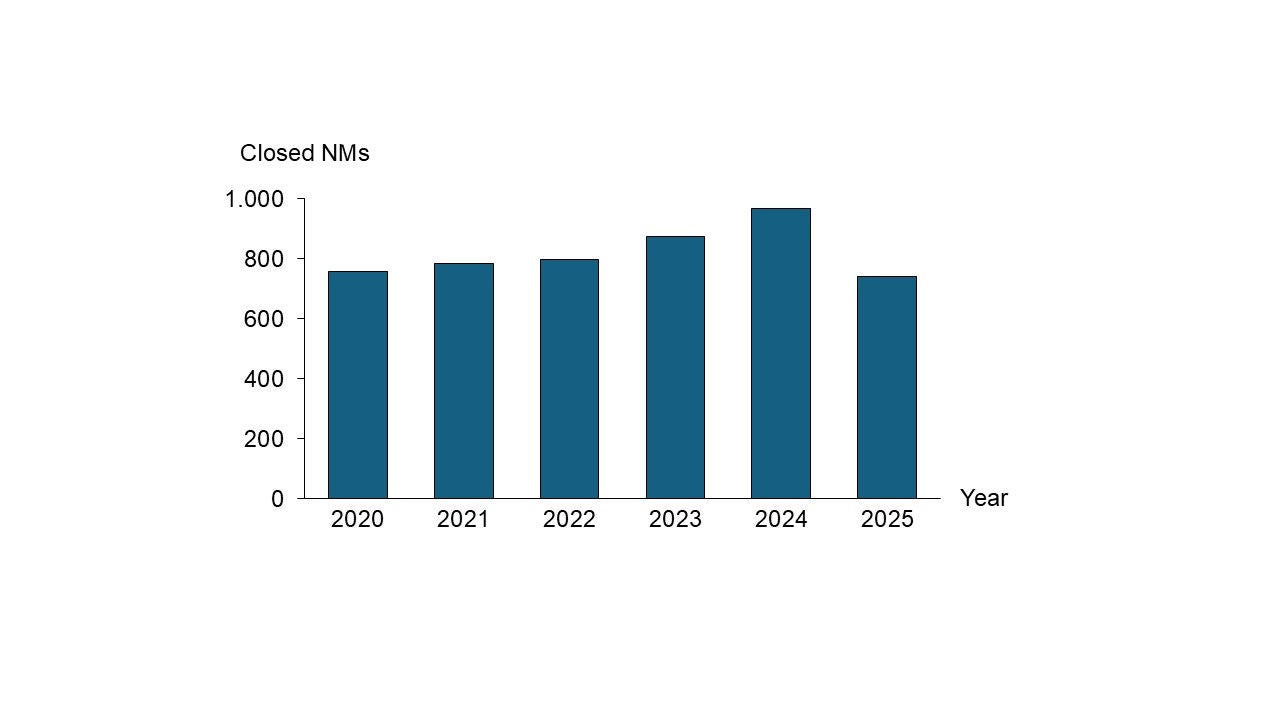
Figure 1: Chart represents the number of closed near misses (NMs) in the period of 2020-2025
Summary
Arxada biotechnology site’s EHS performance reflects a strong combination of structured risk management, robust engineering safeguards, disciplined operational practices, and active employee participation. Through continuous monitoring, strict regulatory compliance, and a culture that prioritizes learning and prevention, the site maintains a safe working environment and minimizes environmental impact. Excellence in safety is not merely a priority - it is the foundation on which all other aspects of our performance stand.
Our offer
- Fully integrated CDMO services in the field of industrial biotechnology
- Engagement at any stage of product/process development
- 99% batch success rate
- Excellent on time in full delivery performance with over 60 processes transferred to commercial scale in the past decade
- 12 years without a Lost Time Injury (LTI)
- Strong focus on safety and continuous process improvement
Authors information
Jan Janousek
EHS Manager

Vratislav Stovicek
Business Development Analyst CDMO
Acknowledgments
This work was funded by Arxada AG, Peter Merian-Strasse 80, 4052 Basel, Switzerland.
For further information and/or if you would like Arxada to support your project(s), get in touch with:
Arxada is an industry leader in science-based specialty chemicals that creates innovative chemistry and solutions. Comprised of two business units, Arxada’s Microbial Control Solutions (MCS) business provides more sustainable, science-based solutions that utilize differentiated capabilities in microbiology, actives delivery and formulation chemistry. Its manufacturing and unmatched regulatory expertise meets customer needs in variety of endmarkets, specifically, Professional Hygiene, Home & Personal Care, Paints & Coating, Wood Protection and Material Protection. Arxada’s Nutrition, Care & Environmental (NCE) business serves the needs of our partners in a diverse range of industries including food and feed supplements, aerospace, electronics, renewables, agriculture and industrial, as well as pharma intermediates. Leveraging our strong vertical integration into chemical building blocks, such as ethylene, acetylene, ketene/diketene and HCN, along with our fermentation capabilities and our deep technical expertise, NCE transforms customer needs into high performing solutions. This is achieved through direct product supply or contract development and manufacturing (CDMO). With major sites strategically located in the heart of Europe, Arxada secures its customers’ supply chains, while actively supporting their sustainability efforts.
Headquartered in Basel, Switzerland, the company’s global footprint spans 24 production sites and 14 R&D centers. Its 3,400 associates contribute daily to its overall success.
To learn more about Arxada, please visit: arxada.com and Arxada on LinkedIn
Disclaimer
All information in this presentation corresponds to Arxada’s knowledge on the subject at the date of publication, but Arxada makes no warranty as to its accuracy or completeness and Arxada assumes no obligation to update it. All information in this presentation is intended for use by recipients experienced and knowledgeable in the field, who are capable of and responsible for independently determining the suitability and to ensure their compliance with applicable law. Proper use of this information is the sole responsibility of the recipient. Republication of this information or related statements is prohibited. Information provided in this presentation by Arxada is not intended and should not be construed as a license to operate under or a recommendation to infringe any patent or other intellectual property right. All trademarks belong to Arxada or its affiliates or to their respective third parties and are used here only for informational purposes. Copyrighted material has been produced with permissions or under license, all other materials.
© 2025 Arxada Ltd.