Health & Safety

Our associates are our greatest asset, and we want to ensure we prioritize safety while fostering a respectful and supportive environment. Health & Safety (H&S) has been identified as one of our three corporate values. Strong safety and health processes are essential to our business.
Our Environmental, Health & Safety (EHS) team oversees our H&S strategy by conducting audits of our operations, addressing remediation issues at our sites, and assuring overall safety compliance. Our NCE and MCS business units share an EHS approach that is supported by our newly established corporate EHS organization. The successful day-to-day implementation of H&S efforts is carried out by operations personnel at each site following guidelines from the EHS team.
By 2030, we aim to achieve:

Safer together at Arxada
Our Safer Together at Arxada initiative reaffirms the H&S culture at Arxada. Led by our corporate EHS team, Safer Together at Arxada focuses on our core values of Safety and Health, Ethical Behavior and Respect for People and Planet. The program aims to engage all associates to work collaboratively and foster new leadership behaviors in safety. It also acts as a key driver for our 2030 H&S goal.
As part of our Safer Together at Arxada commitment, we focus on embedding safety into daily work - not as an abstract expectation, but as a practical, repeatable habit. By equipping employees with simple tools to assess risk before beginning work, we strengthen both individual accountability and operational resilience. This approach is embodied in the CHECKS program.
The CHECKS program, initiated in early 2025, is a core element of Arxada’s commitment to fostering a safe, responsible, and sustainable workplace. Designed to strengthen situational awareness and reinforce safe decision-making, CHECKS provides a simple, memorable framework employees use before beginning any task. By encouraging individuals to pause, assess their environment, and confirm that conditions are safe, the program helps prevent incidents, supports operational reliability, and reinforces a culture where safety is a shared responsibility.
The purpose of CHECKS extends beyond personal safety. By reducing the likelihood of environmental releases, equipment damage, and operational disruptions, the program strengthens the resilience of our operations and supports broader sustainability goals. Embedded into daily routines, CHECKS reinforces the expectation that stopping work when conditions are unsafe is not only accepted—but expected. The program reflects our belief that sustainable performance begins with safe, informed, and attentive actions at every level of the organization.
Arxada corporate EHS communication initiative
To strengthen associate engagement and reinforce leadership behaviors, Arxada launched an organization-wide safety communication initiative in 2025 focused on making safety more visible, consistent, and actionable across all work environments. Led by the Corporate EHS team, this initiative ensures high-quality safety messaging reaches associates working in manufacturing sites, offices, laboratories, and remote settings—reinforcing shared expectations regardless of location or role.
As part of this initiative, Arxada established a structured cadence of monthly safety topics and weekly safety shares. Each month, a common safety topic is developed and communicated across the organization to align discussions around the same priority risk area, while weekly safety shares reinforce these themes through timely, practical insights that connect real-world observations to broader safety objectives. This consistent rhythm strengthens hazard recognition, supports proactive decision-making, and promotes a shared safety mindset.
In addition, Arxada introduced quarterly safety meetings for all associates and a quarterly EHS newsletter distributed company-wide. These forums provide visible leadership engagement and transparent communication on safety performance, EHS initiatives, Serious Injury and Fatality (SIF) validations, employee engagement metrics, KUDOS recognition, lessons learned from incidents, upcoming safety topics, and a dedicated Safety at Home section to extend risk awareness beyond the workplace.
Together, these communication channels reinforce the Safer Together at Arxada program by supporting regular dialogue, consistent expectations, and leadership accountability. By standardizing safety conversations and maintaining frequent touchpoints, Arxada continues to build an engaged, prevention-focused safety culture that supports safe, reliable, and sustainable operations.
Together, we are building a stronger, safer Arxada—one policy, one procedure, and one action at a time.
Creating a health & safety culture
To embed health and safety (H&S) across Arxada, all associates have annual H&S performance goals tailored to their roles and must complete role-specific H&S training. Office and sales staff receive training on topics like phone use while driving, while those handling chemicals receive safe-handling training.
All associates also complete annual refresher training and participate in regular location-specific emergency drills to ensure they have the skills to work safely.
In 2025, Arxada strengthened its Health and Safety culture by redefining all H&S engagements within manufacturing facilities as leadership engagements, reinforcing our commitment to visible, felt leadership. This shift emphasized leaders being present in the field, engaging directly with employees on specific safety topics, and demonstrating accountability through meaningful, in-person dialogue.
As a result of this intentional focus, total H&S engagements decreased from 84,682 in 2024 to 64,201 in 2025. While fewer in number, these engagements required a higher level of preparation, time, and leadership involvement. The change reflects a deliberate move toward quality over quantity—prioritizing deeper, more impactful safety conversations that strengthen trust, reinforce expectations, and actively model safe behaviors.
To further prioritize safety, we conduct SIF (Serious Injury and Fatality) prevention inspections, identifying high-risk activities and implementing proactive mitigation measures. These inspections evaluate 18 key risk areas using a customized checklist. In 2025, we completed 2,335 SIF Inspections, down from 2,817 SIF inspections in 2024. The reduction in SIF inspections in 2025 reflects a sustained improvement in risk management, driven by a 38% decline in SIF potential cases over the past three years. As SIF inspections are risk-based and triggered by identified high severity potential, the reduction in SIF potential cases naturally resulted in fewer required validations. This trend demonstrates the impact of targeted SIF prevention efforts, including leadership engagement, improved work planning, strengthened decision-making at the task level, and enhanced use of tools such as CHECKS to assess conditions before work begins.
While we are working hard to maintain a rigorous and comprehensive H&S culture, incidents can happen. When they do occur, we learn and adapt to prevent recurrences. We utilize two specific approaches:
Root cause analysis: All Tier 1 and Tier 2 incidents undergo formal root cause analysis aligned with Center for Chemical Process Safety definitions, with learnings shared globally to drive consistent improvement.29,30
Power scale ratings: To strengthen a prevention-focused safety culture, in 2025, the Corporate EHS team implemented a structured Power Scale for Corrective Actions that prioritizes addressing root causes rather than surface-level fixes. By emphasizing high-impact, durable solutions—such as engineering and system-based controls- and transparently tracking corrective action strength, the organization reinforces accountability, drives organizational learning, and reduces the likelihood of repeat incidents. This disciplined focus strengthens operational discipline, enhances risk awareness, and supports long-term improvements in health and safety performance.
Management & auditing of sites
The corporate EHS team conducts regular, risk-based audits across all Arxada sites to ensure compliance with regional regulations and internal policies. Sites are categorized by risk to determine audit frequency, with every facility audited at least once every three years. Audits assess risk management systems, EHS performance, and compliance with areas such as H&S practices, emergency preparedness, waste management, industrial hygiene and PPE.
For newly acquired sites, we perform a dedicated EHS gap assessment to identify improvements needed to meet Arxada standards, followed by a 12-18 month action roadmap developed with site teams.
All operational sites maintain up-to-date associate H&S risk assessments that are regularly revised based on regulatory changes, audit findings and safety events, helping ensure safe, compliant and sustainable operations across our global footprint.
Our Health & Safety performance
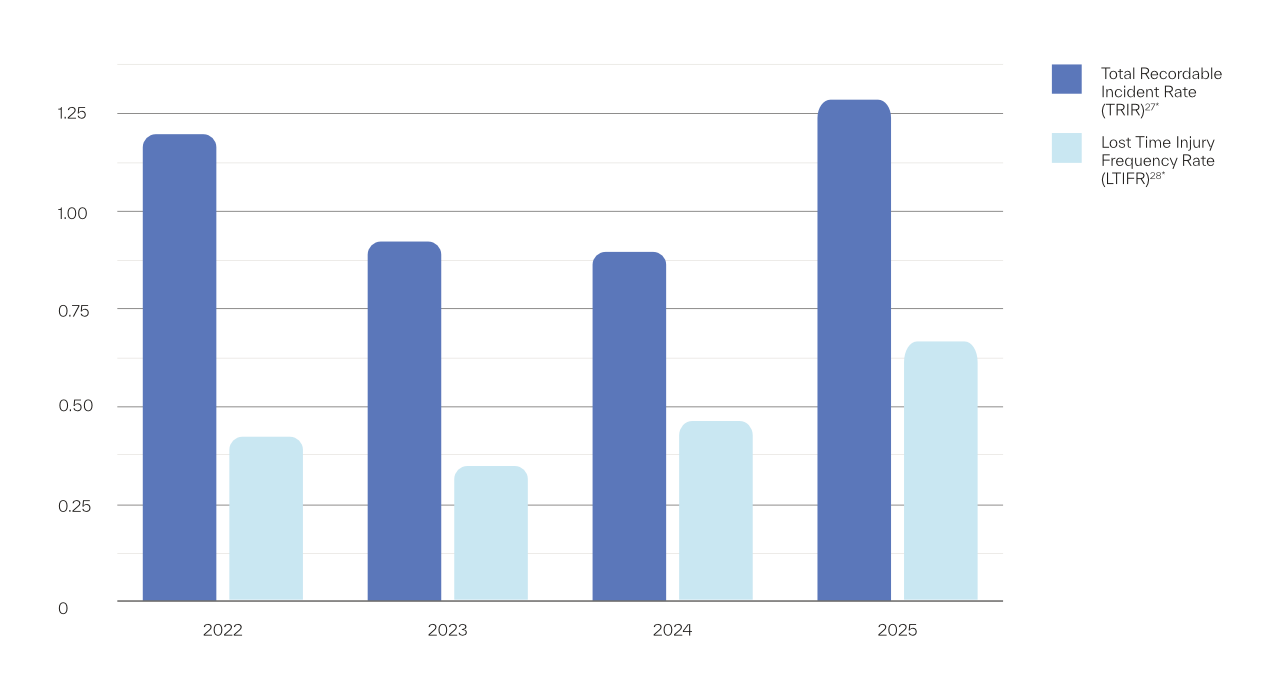
In 2025, Arxada recorded 43 recordable injuries (TRIR 1.2827*) and 22 lost time injuries (LTIFR 0.6628*), compared to 28 recordables (TRIR 0.81) and 16 lost time injuries (LTIFR 0.46) in 2024. In response, targeted improvements planned for 2026 include updates to PPE standards, strengthened slip, trip, and fall prevention, and enhanced equipment and tool safety practices through focused training and inspections. These actions are aligned with the Safer Together at Arxada program and reflect our continued commitment to learning, prevention, and the protection of our people.
Looking forward to 2026
In 2026, we will strengthen our focus on both personal and process safety through targeted, globally aligned initiatives. We will launch a company-wide Slips, Trips and Falls prevention program and implement updates to our Global PPE Standard to establish clear minimum requirements, with the goal of driving reductions in both recordable and lost time injuries across the organization. Our EHS audit program will be refreshed to drive consistency, effectiveness, and actionable insights across all sites, while a new contractor management program will enhance oversight and risk control for third-party activities. To reinforce environmental compliance, we will introduce a centralized regulatory compliance calendar to improve visibility and accountability across the organization. Additionally, the rollout of our Zero Leaks initiative will target loss of containment risks, supporting our continued commitment to process safety excellence and operational discipline.


Visible felt leadership & safety cross green days
Our leaders continued to demonstrate strong commitment to safety through meaningful field engagement and direct employee interaction.
In 2025, Arxada achieved an average of 89% Safety Cross Green Days, significantly exceeding our 60% target. These results reflect visible felt leadership in action-reinforcing safe behaviors, building trust, and supporting our goal of a zero incident workplace.
Serious Injury and Fatality (SIF) inspections
We exceeded our 2025 target of 1,500 SIF validations by completing 2,335 validations across the organization. Each validation represents an opportunity to identify and control high-risk exposures before they result in a serious injury or fatality, reinforcing our proactive approach to SIF prevention.
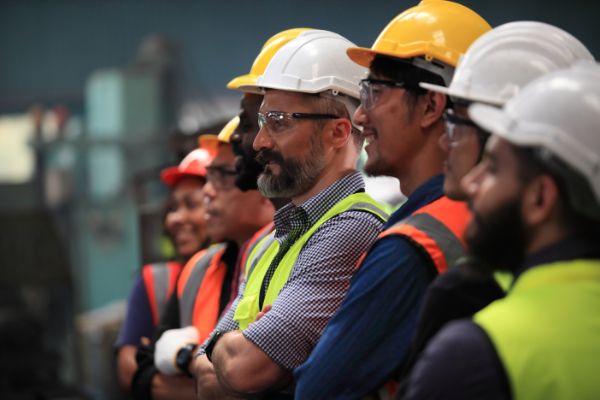
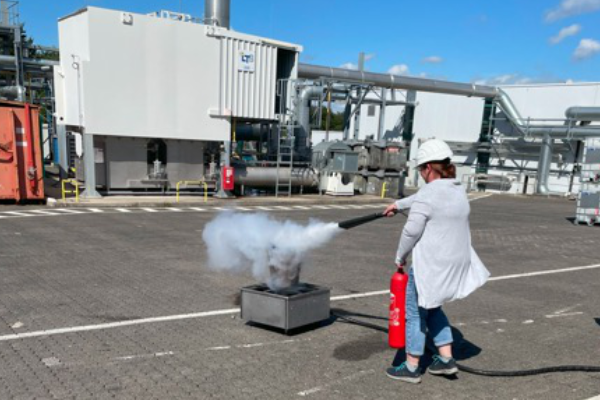
Safety day successfully completed in Horhausen site
Practical, hands-on safety training sessions were conducted at the Horhausen, Germany site to strengthen workplace safety and employee preparedness. These included fire protection training covering the use of different fire extinguishing units, delivered by CWS, forming the foundation for employee qualification as fire safety assistants. In addition, a structured skin protection plan was developed and tested using products from SC Johnson Professional Ltd., supporting improved occupational health practices. Employees also completed practical training on the safe operation of industrial trucks (forklifts), conducted by Staplerzentrum Westerwald, enhancing operational safety and compliance.
EHS excellence recognition
In response to feedback from our safety perception survey, the corporate EHS team launched the EHS Excellence Recognition Program midyear 2025 to strengthen recognition of positive safety actions. The program highlights employee- and site-level efforts that prevent incidents, enhance workplace safety, and support community engagement-ensuring positive behaviors are visible and valued.

27 An injury or illness is considered a recordable incident if it results in any of the following: death, days away from work, restricted work or transfer to another job, medical treatment beyond first aid, or loss of consciousness. Additionally, a significant injury or illness diagnosed by a physician or other licensed healthcare professional is considered a recordable incident, even if it does not result in death, days away from work, restricted work or job transfer, medical treatment beyond first aid, or loss of consciousness.
28 Rates are calculated as the number of injuries in the reporting period x 200,000 / Total hours worked in the reporting period.
* Both TRIR and LTIFR have been limited assured by ERM CVS. For more information please see the "External Assurance Report" which details the scope, activities, and conclusion of their engagement. Arxada’s Basis of Reporting document outlines the scope, principles, and methodologies Arxada applies in preparing the environmental and safety data for this report and other public communications.
29 Leading metrics are a forward-looking set of metrics that indicate the performance of the key work processes, operating discipline, or protection layers that help prevent potential incidents. Lagging metrics are a retrospective set of metrics based on incidents that meet an established threshold of severity.
30 Tier 1 incidents are described as catastrophic and exceed a defined threshold level, whereas a Tier 2 incident is used to normalize the industry metrics and provide a minimum and upper limit threshold range.