Water management

Water is an essential resource across our manufacturing operations, supporting cooling, steam generation, product processing, cleaning, and sanitary functions. With water scarcity emerging as a key concern, the management and optimization of water consumption is central to our sustainability strategy.
Some of our manufacturing sites are located in high water-risk and water-stress areas. Engaging with 100% of the identified sites at water risk or stress helped us to understand our water balance (water withdrawal, consumption and discharges) and establish a comprehensive baseline for the entire organization. We are committing to deploying water management practices at 100% of these sites by 2027.
Water-related risks will be reassessed periodically and have been integrated into Arxada's Enterprise Risk Management System in 2025.
An increasing number of our manufacturing sites already own and operate on-site Waste Water Treatment Plants (WWTP), enabling 100% of the plant’s industrial effluents to be treated and reused internally. This advancement transforms a facility into a zero-effluent site, reducing its reliance
on external water withdrawal. These initiatives not only enhance operational efficiency but also reinforce our commitment to sustainable water management and environmental stewardship.
In 2025, targeted water-efficiency projects in Visp and Williamsport reduced water consumption and process losses through smarter cooling design, condensate recovery, and reliability upgrades, delivering significant resource savings and stronger operational efficiency.
Located near the river Rhone in Visp, our largest manufacturing site benefits from the naturally cold waters of the Swiss Alps, maintaining a temperature of 4°C - 8°C throughout the year. This unique advantage eliminates the need for energy-intensive cooling towers, allowing us to operate our facilities with minimal environmental impact.
Looking forward to 2026
We will continue to engage with our sites and further enhance the collection of water metrics. We plan to monitor recycling rates, reduce water consumption, and foster the implementation of Waste Water Treatment Plants.

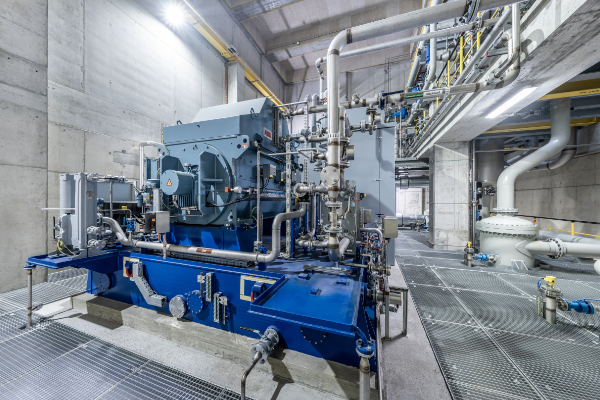
Optimizing cooling water use in acetylene production in Visp
At our Visp site, the acetylene generation unit produces large volumes of raw gas that must be cooled before further processing. This cooling
was traditionally achieved using multiple coolers in parallel, including two high-capacity units that are among the largest individual consumers of Rhone river water on site, each using up to 300 m³/h, comparable to the water demand of entire production plants. A project went into operation in June 2025 to significantly reduce this water consumption. By installing new piping to connect the two coolers in series on the water side, the system now operates as a single, large counterflow heat exchanger. This configuration maintains effective cooling performance, with minimal temperature increase of the Rhone water across each stage. The project saves approximately 100-150 m³/h of water, freeing up a substantial portion of Rhone water capacity and enhancing the site's long-term resource efficiency.
Reliability and recovery improvements enhance water efficiency and reduce process losses in Williamsport
Two targeted reliability and infrastructure upgrades delivered measurable water savings in the Williamsport site. The Steam Condensate Tank Replacement project addressed ongoing losses by installing a new tank to recapture condensate that had previously been leaking to the wastewater treatment system. This intervention is estimated to have saved 2.4 million gallons of water in 2025, significantly improving resource efficiency and reducing unnecessary load on treatment operations.
Complementing this effort, a Pump Reliability project focused on eliminating recurring pump seal failures on the ethoxylator pump that were driving repeated water flushes to drain. By upgrading the pump seals, these losses were prevented at the source, resulting in an estimated 438,000 gallons of water saved in 2025. Together, these initiatives demonstrate how targeted maintenance and equipment improvements can deliver immediate sustainability gains while enhancing operational reliability.